
250 Herbert Avenue
Closter, New Jersey 07624 U.S.A.
1-877-218-2650

Gear backlash is the clearance, or lost motion, between mating gear teeth. It is also one of the most commonly misunderstood variables in gear design.
Backlash is not something engineers automatically eliminate. In practice, it is a design parameter that has to be controlled for the application. Too little clearance can create drag, noise, wear, or thermal sensitivity. Too much clearance can reduce reversal accuracy, create clatter, and increase impact loading.
The useful question is not, “How do I get rid of backlash?” It is, “How much backlash does this system need to perform reliably under its real operating conditions?”
The most common mistake is assuming zero backlash is the target. It usually is not. As Gear Solutions explains in its discussion of why backlash should be optimized rather than eliminated, a gear mesh that is too tight can increase drag, noise, wear, and thermal sensitivity.
That changes how engineers should think about backlash. It is not just an error to measure after the fact. It is a design choice that affects positioning behavior, startup feel, direction reversals, heat generation, and long-term tooth health.
A simple way to picture backlash is a key in a lock. If there is no clearance at all, the key may not insert cleanly once dirt, heat, or slight distortion shows up. Gears behave in a similar way. Tooth flanks need a controlled amount of room so the mesh does not bind when parts warm up, shift slightly in assembly, or carry a lubricant film.
For that reason, backlash belongs on the same list as center distance, material, tooth form, and bearing support. These are all variables engineers choose to achieve a system-level outcome.
Practical rule: Do not specify the lowest possible backlash until the machine’s priority is clear: positioning accuracy, low noise, efficiency, thermal robustness, service life, or some combination of these factors.
Motion-control systems usually push toward tighter backlash because commanded position and actual position need to track closely, especially when direction changes. Many power-transmission systems care less about tiny reversal error and more about smooth running, tolerance absorption, and freedom from interference under load and temperature swing.
That is why asking what is gear backlash? in a design review should lead to a second question immediately: acceptable for what duty? A packaging axis, a door drive, a reduction gearbox, and a cleanroom indexer may all need different backlash targets.
Backlash does not come from one place. Engineers usually see it as the sum of several contributors across the full assembly. If you only look at tooth clearance in isolation, you can miss why the machine feels looser than the drawing suggests.

Some backlash is there on purpose. Engineers leave room for lubrication, thermal expansion, and the ordinary variation that comes with real manufactured parts. A mesh specified so tightly that every component must be perfect at every temperature is not dependable. It is a gearbox that only works under ideal conditions.
In this scenario, the “tight is always better” mindset fails. The useful target is a controlled operating gap, not theoretical zero.
Even with good process control, each component brings small variation into the mesh. Tooth thickness can vary. Tooth profile can vary. Bore location and shaft runout can vary. Housing dimensions and bearing fits can shift center distance enough to change the feel of the gear pair.
A gear pair can look fine on separate component drawings and still produce unwanted free play after assembly because the tolerance stack-up acts in the same direction.
Common contributors include:
Backlash can also grow in service. Every reversal, shock event, contamination event, and lubrication problem can change the tooth flanks. In lightly loaded systems, that growth may be slow and harmless. In reversing drives, noisy geartrains, or abrasive environments, wear can become the dominant source of lost motion.
A machine can start with acceptable backlash and still fail functionally later because wear shifts it outside the useful range for the application.
That distinction matters when diagnosing whether the issue is “bad gears” or “normal play.” Sometimes the gear design is sound, but the support structure, alignment, or wear mode has moved the system out of tolerance.
Backlash problems show up most clearly when a system reverses, starts, stops, or carries variable load. That is when the teeth move from one flank to the other and the clearance becomes visible in motion, sound, or heat.
Too much backlash and too little backlash create different failure patterns. During diagnosis, that distinction matters because the fix for one can make the other worse.
Insufficient backlash usually feels like a geartrain that does not want to run freely. The drive may sound harsh. Current draw may rise. The teeth can run hot because the flanks do not have enough room to separate cleanly as the system turns.
The other risk is temperature sensitivity. A mesh that seems acceptable on the bench may become troublesome after the assembly warms up and the parts expand. Instead of smooth engagement, the system starts to bind.
Excessive backlash creates a different set of symptoms. Reversal accuracy gets worse. The system can rattle under changing torque. Tooth impact increases because the driven flank does not take load immediately. Operators often describe the behavior as clunk, chatter, or slop.
In motion-control equipment, that lost motion often shows up before anything breaks. In heavier power transmission, the concern shifts toward impact loading and the long-term damage that repeated flank-to-flank shock can create.
| Performance factor | Insufficient backlash: too tight | Excessive backlash: too loose |
|---|---|---|
| Positioning behavior | Can feel sticky or inconsistent during motion | Adds lost motion during reversals |
| Noise | Can produce harsh running noise from tight mesh | Can produce rattle or clatter under changing load |
| Heat | Friction and heat tend to increase | Heat may rise indirectly if impact and wear worsen contact conditions |
| Wear pattern | Accelerated wear from rubbing and poor running clearance | Accelerated wear from impact and repeated flank loading |
| Reliability risk | Binding or seizure risk if conditions tighten further | Shock loading and degraded control performance |
| Temperature sensitivity | High, especially if expansion closes the mesh | Lower immediate binding risk, but loose behavior can worsen with wear |
Field note: If a gearbox is noisy only on reversal, suspect excessive backlash first. If it is noisy continuously and gets worse as it warms up, inspect for a mesh that is too tight.
A lot of troubleshooting goes wrong because all backlash issues get collapsed into one bucket. Teams hear noise and immediately try to remove clearance. Sometimes that helps. Sometimes it pushes the gearbox into friction, heat, and premature wear.
Backlash has to be measured at the hardware level, not just assumed from nominal gear geometry. The usual shop-floor method is simple and effective when done carefully.

The standard practical setup uses a dial indicator. One gear is held fixed. The mating gear is rocked gently back and forth without forcing tooth deflection. The indicator shows the free movement before the opposite flank picks up contact.
A clean backlash measurement depends on discipline:
During early design, a gear calculation resource for engineers can help frame the geometry and load questions before prototype measurement.
A drawing should not imply that any measurable play is unacceptable. It should tell manufacturing and assembly what range the design can tolerate. That means defining backlash as a controlled result of the full system, not just a tooth detail floating without context.
Useful backlash specifications usually consider:
The video below shows a practical measurement approach that aligns with what many engineers do during setup and inspection.
A backlash callout works best when it reflects the machine as built and operated. If the drawing only chases a theoretical minimum, assembly technicians will fight the mesh instead of controlling it.
The best backlash strategy depends on what you are trying to protect. Sometimes the priority is reversal accuracy. Sometimes it is low noise. Sometimes it is preventing a gearbox from tightening up across temperature. The method should match the outcome.

Adjustable center distance is one of the most direct tools. It lets the team tune mesh clearance during assembly instead of living entirely with nominal dimensions. That is useful when the housing, shafts, and bearings introduce enough variation that fixed geometry will not reliably land in the target zone.
Preload mechanisms attack backlash differently. A spring-loaded split gear or similar anti-backlash arrangement keeps opposing flanks engaged so reversal play is reduced. That can work well in lighter-load positioning systems. It also introduces extra parts, more friction, and another wear mechanism to evaluate.
Common control methods include:
Do not try to solve a structural compliance problem with tooth mesh alone. If shafts move under load, the backlash reading at rest may tell only part of the story.
For engineers comparing anti-backlash approaches in precision systems, this anti-backlash gear design example in tomography imaging is a useful application reference.
Higher-precision gears can reduce variation in tooth thickness and profile, which helps bring assembled backlash under control. That is valuable, but it is not a complete answer. Precision teeth mounted in a flexible housing can still produce disappointing system behavior.
Geometry choices matter too. Tooth form, face width, and support arrangement all change how forgiving the mesh is. A design that works near the center of its tolerance band usually survives production and service better than one that depends on perfect setup.
Material selection is often underestimated. Low-friction polymer gears can change how tightly a mesh can run because they do not depend on the same lubrication strategy as traditional metal gearsets. In some applications, Intech Corporation’s PowerCore plastic gears are used where engineers want lubrication-free operation and tighter control of backlash behavior without introducing grease into the system.
Polymer gears are not the answer for every gearbox. Load, temperature, duty cycle, stiffness, and wear mode still decide the fit. But when the design problem is tied to lubrication limits, contamination risk, or noise, material choice can be as important as the mechanical anti-backlash feature.
Some applications punish poor backlash choices faster than others. Cleanroom equipment and low-noise motion systems are two clear examples because both expose side effects that many industrial machines can hide for a while.
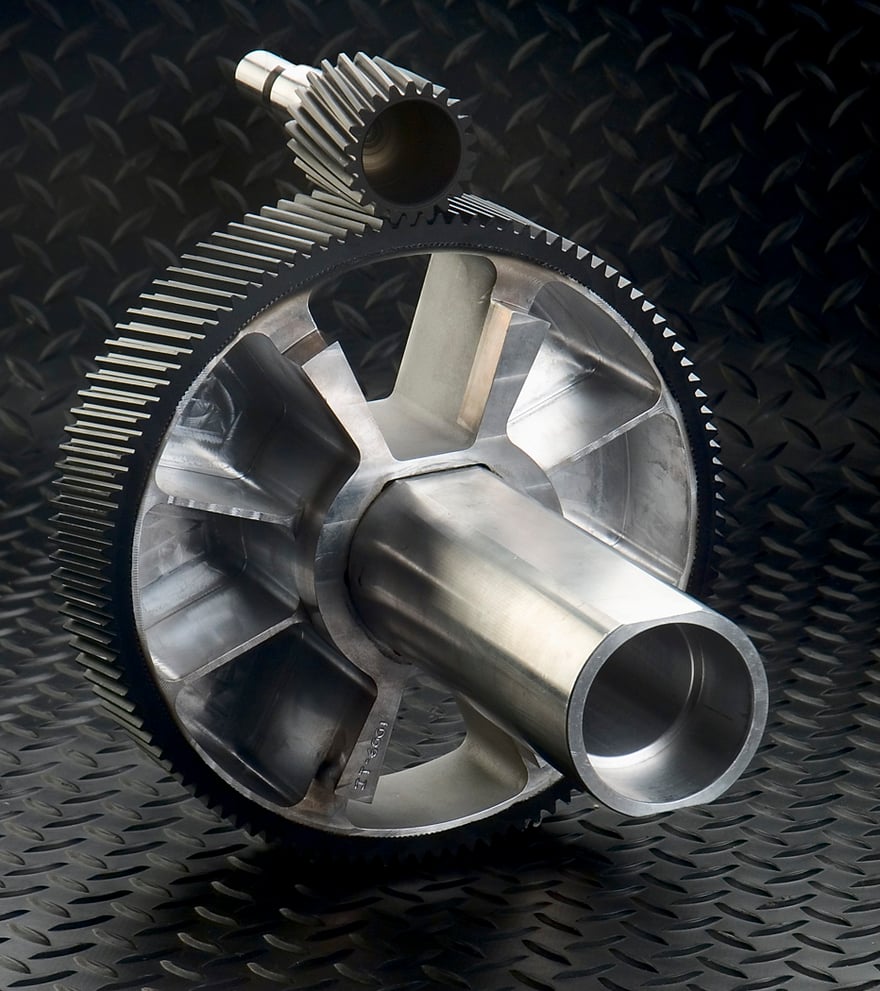
In cleanroom and medical equipment, grease is not just a maintenance choice. It can become a contamination concern. That changes the backlash discussion because one traditional reason for maintaining clearance in metal gear meshes is making room for lubrication and avoiding distress when the mesh tightens.
A non-lubricated gear material changes that trade-off. The engineer can pursue a controlled, tighter running condition without automatically inheriting the same lubrication-related constraints as a conventional metal pair. That does not remove the need to account for temperature, tolerance stack-up, and structural stiffness, but it does open useful design space.
For teams working on contamination-sensitive motion, this cleanroom rotary positioning example without grease lubrication shows why backlash control and material choice are tightly connected.
Backlash affects noise in two ways. Excessive clearance can let teeth strike more abruptly during reversals or fluctuating load. An overly tight mesh can also get loud because the teeth rub and run harshly. Quiet systems usually live in the middle, where engagement is controlled but not forced.
Damping is a critical factor. Metal geartrains tend to pass vibration efficiently through the structure. Engineered polymers can help reduce that transmission while also supporting a backlash target appropriate for the motion profile. In practical terms, the quietest result usually comes from combining three decisions: a stable support structure, a realistic backlash range, and a material that does not amplify contact noise.
Quiet geartrains rarely come from one heroic fix. They come from a mesh that engages smoothly, stays stable across temperature, and does not rely on impact to transfer torque.
No. Some backlash is intentional and necessary. The problem is not the existence of backlash. The problem is having the wrong amount for the application.
Gear backlash is the small amount of free movement between mating gear teeth before the opposite tooth flank takes load. You usually notice it most clearly when the drive changes direction.
Yes. Wear on the tooth flanks, support motion, and assembly loosening can all increase system backlash as the machine runs.
Not automatically. Lower backlash can improve reversal response, but if the mesh becomes too tight, the system can pick up friction, heat, noise, and inconsistent motion. Accuracy depends on the whole drivetrain, not just the smallest possible clearance.
Backlash complaints are often caused by one of three conditions:
Start with the machine function. Ask what matters most at reversal, at operating temperature, and at full load. Then specify a backlash range that the full assembly can hold, rather than chasing theoretical zero at one condition.
If backlash, noise, lubrication limits, or cleanliness are affecting your motion or power transmission design, Intech Corporation can help evaluate material and gear design options for the actual operating environment.